

2025 will mark an important moment in the advancement of artificial intelligence in which Autonomous Agents transition from the realm of theoretical ideas and specialized applications to ubiquitous instruments that are transforming industries scientific research and everyday life. The “Autonomous Agents Guide 2025” is comprehensive study of this revolutionary technology. It provides insight on their fundamental principles and applications as well as their challenges as well as the exciting path of their growth.
Over the years the notion of intelligent beings capable of taking decisions on their own acting autonomously and gaining knowledge from their environment has fascinated both futurists and scientists. In the present as result of advances in computation power machine learning sensors and other technologies and sensors the dream is transforming into concrete Autonomous Agents.
Self driving vehicles that navigate complicated urban terrains AI powered personal assistants who manage our time as well as robotic devices that improve manufacturing processes the power on the world of Autonomous Agents is evident and increasing rapidly. This guide is the ultimate source for learning about this revolutionary concept.
Part 1: Defining Autonomous Agents & What Are They and How Do They Work?
In essence an autonomous Agent is an autonomous system that can operate with no direct intervention from humans in order to accomplish specific objectives.
The autonomy of autonomous agents isnt absolute and is found in range which ranges from very restricted task specific agents up to general purpose intelligent systems. Knowing the basic aspects and the architectural elements in Autonomous Agents is essential to understand their strengths and shortcomings.
1.1 Key Characteristics of Autonomous Agents
Several defining characteristics set Autonomous Agents apart:
- Autonomy It is the ability of HTML0 to work without the constant supervision of human. This is the main characteristic of Autonomous Agents. They are able to perceive their environment as they make their decisions then perform actions in way that is independent.
- Proactivity Contrary to systems that are reactive which simply respond to stimulus Autonomous Agents are able to initiate actions in pursuit of their targets. They dont simply expect commands they are actively seeking out goals.
- Reactivity In spite of their proactive nature Autonomous Agents should also be able to react and responsive to any unexpected events and changes in their surroundings. This is essential for robust Autonomous Agents.
- Goal Oriented Behavior Each autonomous agent is built to accomplish some or all of the objectives that drive its actions and decisions. Clarity of the goals are essential to the success of Autonomous Agents.
- Learn and Adaptability lot of sophisticated Autonomous Agents incorporate machine learning abilities allowing the agents to increase their efficiency as time passes to adapt to changing conditions as well as learn from their previous experience. This is what makes Autonomous Agents increasingly advanced.
- Communication (Optional but common): Autonomous Agents frequently require to connect with humans other agents or other systems in order for coordination of actions to share data or get updates on their targets. This is an essential aspect of multi agent systems.
1.2 The Architecture of an Autonomous Agent
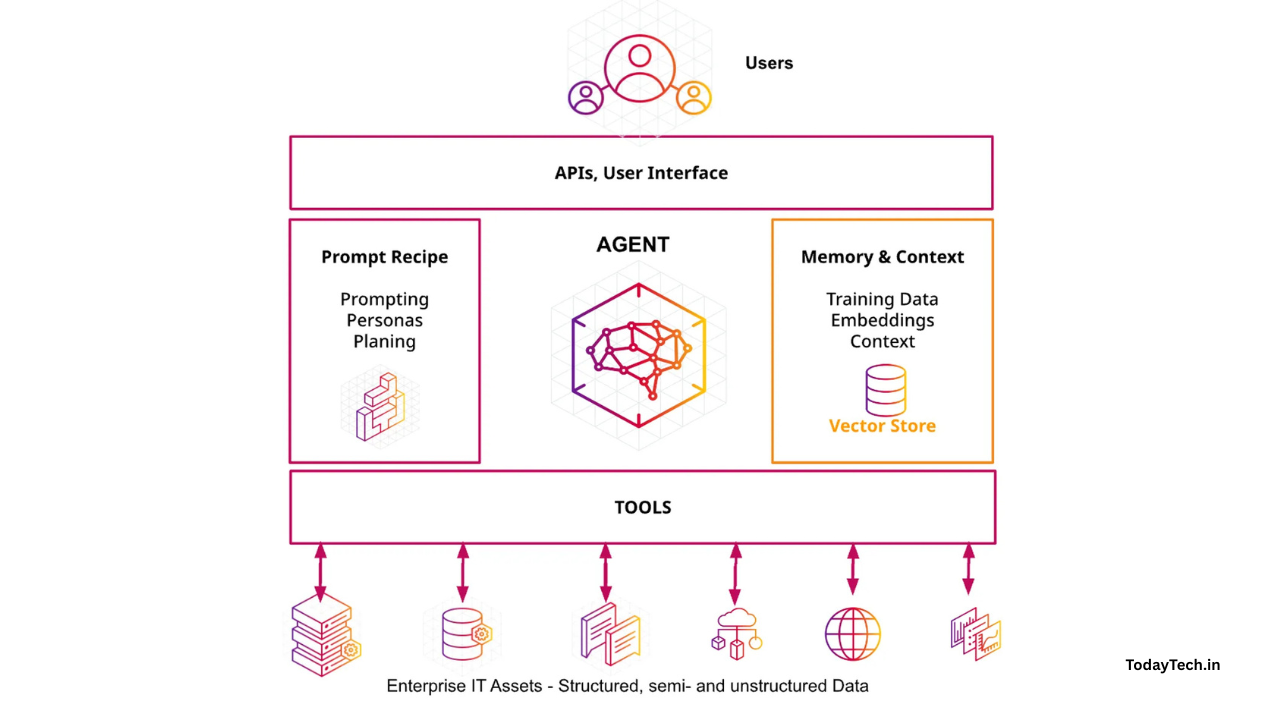
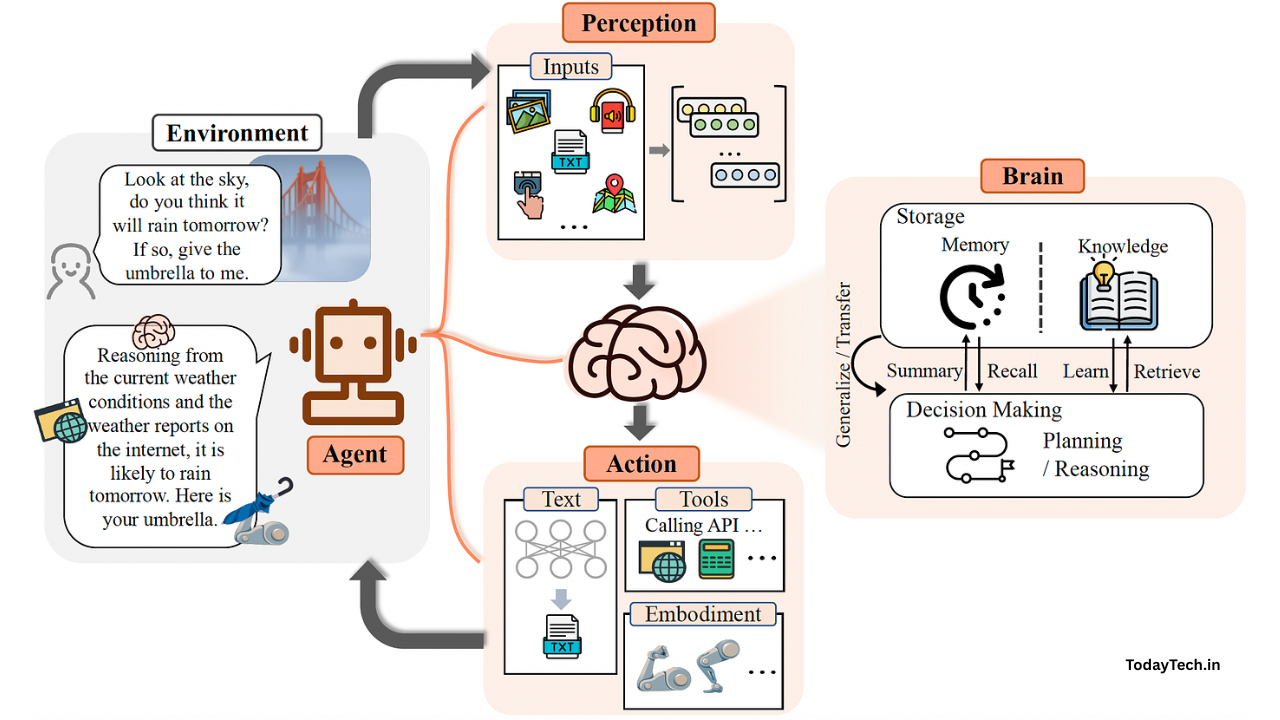
Architectures vary greatly in relation to the level of complexity and the purpose of its use typical conceptual framework has several key elements:
- Sensors They allow an autonomous agent to sense its surroundings. The sensors could be anything from cameras and microphones to lidar sensors for radar and even touch used by physical robots to data feeds databases as well as network interfaces to software agents.
- Perception System The raw sensor data tends to be unstructured and noisy. The perception system analyzes the data in order to produce an effective description of the surrounding environment and to identify objects states and other relevant information. This is the reason AI models such as computer vision as well as natural language processing can play an important role in the development of many Autonomous Agents.
- Knowledge Base/Memory Autonomous Agents keep track of their surroundings and past experiences as well as guidelines and objectives. It is essential to make informed decisions and learn.
- Decision Making/Reasoning Engine: This is the “brain” of the Autonomous Agent. It analyzes the information it receives it scours the database of knowledge employs the reasoning algorithm (e.g. rule based system algorithms for planning and models for reinforcement learning) and then determines what is the best course of action in order to accomplish its objectives. This is an intricate part of an advanced autonomous Agent.
- Actuators They are mechanisms that allow the autonomous Agent interacts with the environment. The most common actuators for robots include motors grippers and wheels. In the case of software agents this might include API requests databases update emailing sending messages or the execution of code.
- Learning Module (Optional but growing): This component lets an autonomous agent to enhance its performance with various methods of machine learning like reinforcement learning supervising learning as well as unsupervised. This improves the efficiency over time for Autonomous Agents.
A great illustration of an autonomous Agent can be seen in robotic vacuum cleaner. The sensors (infrared bump) detect the presence of obstacles. The perception system can identify straight routes. The knowledge base of the system contains an outline of the space. Its decision making engine plans cleaning path. The actuators (wheels or brushes) implement the program. Additionally it has learning modules that aid in optimizing paths in the course of time.
1.3 Types of Autonomous Agents
Autonomous Agents can be classified in many ways however typical distinction is made based on their complexity as well as the character of their environments:
- Simple Reflex Agents They act in accordance with current state perceptions with no memory of previous states. Examples: thermostat that turns to off/on based upon temperature.
- Model Based Reflex Agents They maintain an internal representation of the world that allows them to handle partly observable surroundings. They make use of past experiences to determine the state of affairs.
- Goal Based Agents They consider the the future and its outcomes to accomplish specific objectives typically using the search and planning algorithm. Autonomous vehicles are great example of goal oriented Autonomous Agents.
- Utility Based Agents They are like goals based agents but they also take into account their “utility” or desirability of various states and actions in order to optimize the best outcomes. This is essential for complicated Autonomous Agents in complex environments.
- Learners: As discussed they adapt and increase their capabilities over time using their experience to improve. The most modern and sophisticated Autonomous Agents incorporate the ability to learn.
The rapid development of these various kinds of Autonomous Agents is evidence of the fast advancements in AI research and creation.
Part 2: The Transformative Impact of Autonomous Agents Across Industries in 2025
In 2030 Autonomous Agents will no longer be an idea that is deemed futuristic but instead an integral operational part of many sectors. The capability to automatize repetitive tasks improve complex processes and work in conditions that are hazardous to human beings is driving incredible productivity creativity and security. This article focuses on the major significance that comes from Autonomous Agents in different industries.
2.1 Manufacturing and Logistics: The Automated Backbone
Logistics and manufacturing are among the early adopters of automation. Autonomous Agents are going to take this to the next stage.
- Smart factories: In 2025 smart factories will be home to crowds of robots that collaborate (cobots) and automated Guidance Vehicles (AGVs) as prime instances of Autonomous Agents. They work with human workers tackling risky or difficult ergonomic tasks as well as ensuring accuracy when assembling as well as controlling inventories.
- Supply Chain Optimization Autonomous Agents have revolutionized the management of supply chains. AI powered agents can predict fluctuations in demand and optimize logistics for warehousing and manage scheduling of fleets to autonomous trucks as well as orchestrate drone delivery in specific regions. The gains in efficiency that are derived from this type of Autonomous Agents are massive.
- Quality Control Robotics with high precision Autonomous Agents equipped with sophisticated vision systems conduct constant real time quality inspections on the production line and can spot the defects more accurately and quickly than human inspectors thus reducing the amount of waste and increasing consistency of the product.
- Warehouse Automation Warehouses that are fully automated with robots Autonomous Agents pick the sort and pack merchandise are increasingly the norm significantly cutting operational expenses while increasing the efficiency. The robotic Autonomous Agents operate in continuous and efficient manner.
2.2 Healthcare: Enhancing Care and Accelerating Discovery
Autonomous Agents are set to revolutionize healthcare in all aspects from patient care to medical research.
- surgical robotics: Human surgeons are in charge surgical robots Autonomous Agents provide unmatched precision dexterity as well as minimally invasive features which result in faster healing times for patients.
- Personalized Medicine AI powered Autonomous Agents analyze huge amounts of genomic data and patient information to create personalized treatments anticipate progress of diseases and provide doses of drugs that are based on individual reactions. They are sophisticated Autonomous Agents are revolutionizing the game.
- Drug Discovery Autonomous Agents speed up the process of discovering drugs through simulating molecular interactions the screening of potential candidates for drugs and enhancing experimental protocols and significantly cutting down the amount of time and expense involved in the introduction of new drugs to commercialization.
- Hospital Operation: Hospitals have Autonomous Agents handle duties like providing medications in sterilizing rooms and moving linens around allowing medical personnel to concentrate on providing care to patients. They also handle logistical tasks. Autonomous Agents improve the efficiency of hospitals.
- Senior Care and Assistance: Companion robots and remote monitoring Autonomous Agents provide aid to seniors and handicapped people. They assist with everyday tasks including medication reminders medications as well as emergency alerts which help to promote more independence.
2.3 Transportation and Logistics: The Road to Autonomy
The concept of autonomous transport is quickly becoming reality due to the advancement of Autonomous Agents.
- Autonomous Vehicles: From passenger vehicles to long haul truck autonomous vehicles Autonomous Agents are progressing significantly. Although fully Level 5 autonomousness (no human interaction never) is not yet at the edge Level 3 4 and 3 systems have become more commonplace increasing security and efficiency.
- Air Traffic Management Artificial Intelligence powered Autonomous Agents are helping air traffic controllers with improving flight routes controlling airspace and anticipating potential conflicts which can lead to better and safer flight travel.
- Drone Inspection and Delivery: Beyond logistical requirements drones Autonomous Agents are utilized for the inspection of infrastructure (bridges power lines bridges) as well as monitoring agricultural operations as well as search and rescue missions that operate in places which are not accessible or hazardous to humans.
- The Public Transit: Autonomous shuttle trains and buses are placed in controlled areas which improve the reliability as well as accessibility to public transport. They are public service Autonomous Agents are improving urban mobility.
2.4 Finance and Business: Intelligent Automation and Risk Management
The financial industry because of the dependence on data and intricate decision making process makes it perfect choice with Autonomous Agents.
- Algorithmic Trading High frequency traders use Autonomous Agents to make trades at speed and in way that is unimaginable for human beings and reacting to market movements in real time.
- Fraud Detection Artificial Intelligence powered Autonomous Agents continuously examine transactions and detect suspicious patterns faster and with greater accuracy than conventional methods securing the financial institution and its the customers.
- Customer Support: Virtual assistants chatbots which are becoming advanced Autonomous Agents take care of substantial number of inquiries from customers offering rapid support helping to resolve basic issues and then escalating complicated cases to human agents.
- Personalized Financial Advice Robo advisors which is kind of Autonomous Agent that provide individualized guidance on investing and managing portfolios depending on your expectations for risk and financial goals giving sophisticated financial advice available to larger audience.
- Risk Assessment Autonomous Agents examine vast data sets to evaluate the risk of credit markets risk credit risk as well as operational risk. This provides better and more dynamic risk assessments for both businesses as well as financial institutions.
2.5 Defense and Security: Advanced Surveillance and Response
Autonomous Agents are taking on greater role in the national security and defense however they are accompanied by significant ethical concerns.
- Surveillance drones: Drones that are autonomous Autonomous Agents perform lengthy surveillance tasks capturing information and monitoring large zones without pilots.
- CybersecurityI driven Autonomous Agents continually look over networks for security dangers identify anomalies and then automatically react to cyberattacks. It provides proactive protection against ever changing cyber attacks.
- AGVs that are autonomous (AGVs): In military settings AGVs serve in logistics as well as in reconnaissance and detonating explosive devices that reduce the risk of human beings being exposed to danger. They are durable Autonomous Agents are made for harsh environments.
2.6 Personal and Domestic Use: Everyday Intelligent Companions
Everyday Autonomous Agents are integrating more and useful.
- smart home systems: Integrated smart home Autonomous Agents learn individual preferences and adjust the temperature lighting and security for the comfort of the occupant and efficiency in energy usage.
- Personal Assistants Virtual assistants that are advanced are more than basic commands and are proactively organizing schedules making recommendations as well as anticipating user demands based upon patterns that have been learned real instances of personal Autonomous Agents.
- robotic lawn Mowers and vacuum cleaners These home based Autonomous Agents handle tasks that are routine freeing the time of humans to pursue other tasks.
The widespread use in Autonomous Agents across these industries demonstrates their significant influence bringing about an age that is unprecedented in automation and smart help.
Part 3: The Technologies Powering Autonomous Agents in 2025
The amazing capability in Autonomous Agents are not the result of any singular breakthrough instead they are the result of the development and convergence of various technological advancements. In 2025 these fundamental elements will have reached new heights of sophistication that allow for stronger more intelligent and adaptable Autonomous Agents.
3.1 Artificial Intelligence and Machine Learning (AI/ML)
AI and ML constitute the base on the which contemporary Autonomous Agents are constructed.
- Deep Learning Neural networks in particular deep learning models enhance the decision making and perception capabilities of variety of Autonomous Agents. From recognition of images by self driving automobiles to understanding natural languages in virtual assistants. Deep learning allows you to recognize complex patterns in massive data sets. This is vital for the development of intelligent Autonomous Agents.
- Reinforcement Learning (RL): RL is vital for teaching Autonomous Agents to take sequential actions in highly dynamic situations. Through trials and errors and getting rewards for actions that are desired and repercussions for actions that are not Agents trained with RL can attain optimal behavior in challenging jobs like robotic manipulation gaming and allocation of resources. Iterative learning is the key to the development of advanced Autonomous Agents.
- Explanable AI (XAI): As Autonomous Agents become more important understanding what drives them to make decisions is crucial. they take certain actions is essential. Techniques for XAI are being created to give transparency and insight to AI models. They are particularly relevant in the field of safety critical Autonomous Agents in sectors like healthcare autonomous driving.
- Federated Learning The approach can allow Autonomous Agents to jointly learn from data sets that are decentralized without sharing raw data. increasing security and privacy particularly in distributed systems composed that comprise Autonomous Agents.
3.2 Advanced Sensing and Perception
The capability for Autonomous Agents to precisely perceive their surroundings is essential to their work.
- Radar and Lidar: These two technologies offer precise 3D mapping as well as object detection essential in autonomous robotics and vehicles working in physical environments that are complex.
- High Resolution cameras and computer Vision: Sophisticated computer vision algorithms typically supported by deep learning allow Autonomous Agents to analyze visual information identify the movement of objects and decode semantic data through images as well as video feeds.
- Infrared and Ultrasonic Sensors They are used for distance detection obstacle avoidance as well as mapping within closer areas which is common to several robots. Autonomous Agents.
- Biometric Sensors For healthcare or personal Autonomous Agents sensors that measure temperatures heart rate and various other physiological information are essential for obtaining vital data.
- Sensor Fusion Integration and smart processing of multiple sensors allows Autonomous Agents to build more complete and accurate comprehension of their environment eliminating the limitations of one sensor. This is essential for the reliability of Autonomous Agents.
3.3 Robotics and Actuation Systems
Physical Autonomous Agents the hardware used to facilitate interactions and movement is as crucial as the software.
- Advanced Robotics The reduction of power the improvement in efficiency and higher quality actuators (motors or grippers) have led to extremely flexible and agile automated Autonomous Agents.
- Soft Robotics In 2025 soft robotics is new technology that uses standards compliant designs and materials that allow robots to communicate more securely with human beings and be able to adapt to surfaces that are irregular and new applications for collaborative and assistive Autonomous Agents.
- Exoskeletons Haptics and other: Human Agent Interaction Haptic feedback systems haptic feedback systems as well as exoskeletons powered by electricity enhance sensorimotor control specifically in remote control for Autonomous Agents.
3.4 Edge Computing and Connectivity
The processing of data near to its source is ever more essential for the real time operation for Autonomous Agents.
- Edge AI The use of AI based models on devices at the edge (sensors or robots) minimizes latency helps conserve bandwidth and increases security allowing Autonomous Agents to quickly make decisions on the spot without the need for cloud connectivity. This is crucial for critical mission Autonomous Agents.
- 5G and More The high speed low latency 5G networks offer the infrastructure for communication that allows dispersed Autonomous Agents to collaborate exchange data and connect to cloud resources as they are required. With the advent of 6G we can expect the possibility of even more advanced capabilities for connected Autonomous Agents.
- Swarm Intelligence This type of system includes multiple more simple Autonomous Agents coordinating to complete complex tasks an individual agent cannot. Decentralized communication and decision making is essential and often facilitated through strong connectivity.
3.5 Simulation and Digital Twins
The process of developing and testing Autonomous Agents in situations in the real world can be expensive as well as time consuming and potentially hazardous.
- High Fidelity Simulations: Simulation environments that are realistic allow users to evaluate train and test Autonomous Agents in the safe and controlled virtual world speeding the development process.
- Digital Twins: Digital twins are an exact replica of tangible object process or system. To be used with Autonomous Agents the digital twin is real time interactive models which can be utilized to monitor predict maintenance and optimizing the agents behaviour in industrial environments that are complex. It allows continuous improvement of the deployed Autonomous Agents.
They form solid foundation on which the technological advancements in Autonomous Agents in 2025 are built. This will lead to forward the development of technology and expanding the scope of automated intelligence.
Part 4: Challenges and Ethical Considerations for Autonomous Agents in 2025
Although the potential that comes with Autonomous Agents is enormous their broad acceptance and growing sophistication brings up significant issues and require an attentive consideration of ethical issues. The solution to these problems is crucial to ensure they Autonomous Agents benefit humanity in responsible way.
4.1 Technical Challenges
Despite the rapid progress many technological hurdles still remain to overcome for Autonomous Agents:
- Robustness in Unpredictable Environments Autonomous Agents frequently face unexpected situations as well as “edge cases” that were not included in their initial training knowledge base. Making sure that they perform reliably in fluid unpredictable and unstructured situations is significant challenge particularly for safety sensitive Autonomous Agents.
- Transfer and generalization: Training Autonomous Agents specifically for particular area or task is difficult to transfer over to other tasks or environments. The development of agents that are able to generalize their understanding and rapidly adapt to changing tasks or areas that require minimal training is hot area for research.
- energy efficiency: for mobile robots Autonomous Agents the power usage is an essential limitation. The development of more energy efficient equipment and algorithms is vital to prolonging the operational time.
- Complexity and Scalability: Coordinating and managing massive numbers of various Autonomous Agents in complicated systems poses significant difficulties with respect to communicating resource allocation and failure tolerance.
- Human Agent Collaborative: The creation of Autonomous Agents that are able to effectively and easily collaborate with humans while recognizing the human mind and adjusting their behaviour accordingly yet difficult task.
4.2 Ethical and Societal Concerns
The growth of the powerful Autonomous Agents raises fundamental ethical and social issues that require thoughtful consideration as well as strategic policymaking.
- Employment Displacement One of the biggest issues is the possibility for Autonomous Agents to replace tasks performed by human beings resulting in the displacement of jobs across variety of industries. Although new positions may be created in the future the period of transition as well as the need for retraining are substantial.
- discrimination and bias: If the data utilized to train Autonomous Agents reflects current biases in society then they themselves could reinforce and sometimes even increase the biases that result in disparate outcomes in the areas of hiring lending and even in law enforcement. Fairness and fairness in Autonomous Agents is crucial.
- Reputability and Liability In the event that an autonomous agent commits mistake or cause harm and harm whos responsible? Who is responsible? Is it the creator the manufacturer person who deploys the agent or even the agent? Setting up clear guidelines for accountability and accountability is essential to the safety of Autonomous Agents.
- Privacy Issues Autonomous Agents particularly those that have extensive sensor capabilities (e.g. devices for smart homes devices or surveillance drones) gather huge quantities of data about individuals. The protection of this information from misuse and maintaining privacy is major problem.
- Security vulnerabilities: Autonomous Agents could be targets of cyber attacks. An autonomous system that is compromised can be altered to cause destruction to steal information or even disrupt vital infrastructure. Security measures that are robust and secure are crucial for every Autonomous Agents.
- Autonomous Weapons Systems (AWS): The development of deadly Autonomous Agents that are capable of identifying and engaging with targets that do not require human intervention raises serious ethical issues regarding the dehumanization of war and the risk of an unintentional increase in violence. This may be the most contested area in relation to Autonomous Agents.
- Human control and Decision Making: As Autonomous Agents get more advanced and sophisticated ensuring that humans have meaningful control as well as ensuring that the agents work within the predefined boundaries of ethics becomes ever more crucial. It is the “human in the loop” or “human on the loop” concept is essential for lot of Autonomous Agents.
- Deskilling and Dependency: Relying too heavily upon Autonomous Agents could cause decline in the human capacity or thinking capabilities if the tasks have been completely delegated to robots.
4.3 Regulatory and Policy Challenges
The international community and government agencies are pondering ways to efficiently control Autonomous Agents without restricting the flow of ideas.
- Inadequate Unified Regulations: The rapid development of technology frequently exceeds the capacity of the legal and regulatory frameworks to meet the demands of technology. Ununified regulatory frameworks may hinder cross border adoption and lead to legal ambiguities in the field of Autonomous Agents.
- Standardization Setting common guidelines to ensure safety efficiency as well as interoperability between different types of Autonomous Agents is vital for widespread acceptance and security.
- Certification and testing developing robust ways of certification of the security and reliability of Autonomous Agents particularly in real world complex situations poses major issue.
- international Cooperation: Many challenges associated with Autonomous Agents including autonomous weapons and trans border data flow demand international collaboration to create efficient global norms and regulations.
The solution to these problems requires the use of variety of approaches that include the ethicists technologists in addition to policymakers as well as the general public. Collaboration and open dialogue will help harness the power for Autonomous Agents while reducing their risk.
Part 5: The Future of Autonomous Agents Beyond 2025
In the years to come The future for Autonomous Agents is growing in terms of technological sophistication integration and the ability to communicate. In the years ahead you will experience major advancements that will push the limits of what intelligent machines can do changing the way we think about our technology environment and our society.
5.1 Greater Autonomy and General Intelligence
- truly proactive and self learning Agents We can expect Autonomous Agents to be even better at making their own sub goals as well as exploring innovative solutions as well as continuously adapting and learning in the absence of human supervision. This will lead to an intelligence that is more general in nature for Autonomous Agents.
- Development of “Artificial General Intelligence (AGI) Components”: While complete AGI (human level intelligence in every domain) remains an elusive goal however individuals Autonomous Agents will start to show more generalized ability to tackle problems in specific broad areas drawing on huge foundational models as well as sophisticated thinking.
- Lang Term Memory Contextual Understanding In the future Autonomous Agents will be equipped with more sophisticated long term memory mechanisms which will allow them to use the years of experience as well as context in order to make their own decisions and create more complex and human like interactions.
5.2 Seamless Human Agent Collaboration and Interaction
- Interactive Interfaces The interaction through Autonomous Agents will improve in the sense that they are much more natural intuitive and natural using sophisticated natural language processing techniques gesture recognition and the brain computer interface (BCIs) to provide effortless control and communication.
- empathy and emotional intelligence (Narrow): While real emotional understanding can be bit complicated Autonomous Agents are expected to increasingly recognize and respond to human emotions with empathetic and functional ways which will enhance their use for customer care healthcare and even education. The result is that human interactions in the presence of Autonomous Agents more fluid.
- Mixed Reality Integration Autonomous Agents can operate in and enhance the mixed reality (augmented as well as virtual) environments by providing smart overlays real time help and immersive experiences that mix both the digital and physical realms.
5.3 Swarm Intelligence and Collaborative Ecosystems
- Hyper Distributed Systems: The future will be vast network that are highly specialized and interconnected Autonomous Agents working together to tackle difficult issues. Imagine city wide traffic management networks smart grids or networks for environmental monitoring made up of thousands of linked Autonomous Agents.
- Self Organizing Self Healing and Auto Healing Systems The complex systems of multi agents are able to self organize and adapt to changes and self heal after failures showing the highest degree of resilience and durability.
- global collaboration platforms Platforms will be created which will allow various organisations or individuals to use and connect the capabilities of their Autonomous Agents into larger collaboration networks to tackle worldwide issues such as the effects of climate change epidemics of disease and disaster relief.
5.4 Specialized Autonomous Agents for Extreme Environments
- Deep Space Exploration: Autonomous Agents can play greater part for deep space exploration missions. conducting complex experiments in science using robotic probes and possibly even building infrastructure off world without human involvement due to the communication delay.
- Deep Sea Exploration: Robotic Autonomous Agents will continue to chart the bottom of oceans identify new species and study marine ecosystems in conditions that are too harsh for sustained human activity.
- hazardous industrial environments: Expect more robust and more specialized Autonomous Agents for jobs like nuclear decommissioning chemical plant inspection as well as mining under hazardous conditions as well as ensuring the safety of humans.
5.5 Ethical AI and Regulation Maturation
- Flexible Regulatory Frameworks Governments are expected to develop more advanced and adaptable regulatory frameworks that are able to balance innovation along with privacy security as well as ethical concerns to Autonomous Agents. The frameworks they develop will be flexible and they will be iterative.
- AI Ethics By the Design Ethics considerations are going to be incorporated into the development and design procedure of Autonomous Agents from beginning instead of becoming added as an extra curricular consideration. It includes transparency fairness and principles of accountability.
- Global Governance and Autonomous Agents: International organizations will play an ever significant role in the development of international norms and conventions especially for the most influential Autonomous Agents such as autonomous weapon systems as well as those that affect international trade.
5.6 Resource Optimization and Sustainability
- Energy efficient AI Hardware Continuous innovation and advancement in special AI chips and neuromorphic computation can lead to more energy efficient Autonomous Agents essential for deployments at the edge and sustainability AI advancement.
- Sustainable Resource Management Autonomous Agents can be crucial in optimizing the allocation of resources to ensure the environment controlling smart grids and optimizing agriculture yields using precision farming and the monitoring of ecosystems to ensure their health.
The path towards Autonomous Agents is just beginning but the impact they have already had is massive. The landscape post 2025 will be shaped by rapid speed of technology advancement which will push the limits of autonomous intelligence as well as human machine cooperation. When these technologies become mature responsibly mindful development and intelligent oversight will be crucial in unlocking their full potential in more efficient as well as sustainable future.
Conclusion: The Era of Intelligent Autonomy
“Autonomous Agents Guide 2025 “Autonomous Agents Guide 2025” provides comprehensive overview of rapidly evolving technology which is changing the world.
From their fundamental definitions and architectural components to their pervasive impact across diverse industries manufacturing healthcare finance transportation and beyond Autonomous Agents are unequivocally at the forefront of the next wave of technological evolution.
Weve explored the advanced technologies which power these intelligent machines and have examined the advances that have been made in reinforcement learning cutting edge sensing edge computing solid simulation.
But the tale about Autonomous Agents is not just about unrestrained technological advancement. The guide also looked at the major technological ethical as well as the societal issues associated with the rise of autonomous systems.
Concerns related to the loss of jobs biases in algorithms issues of accountability and the wide ranging consequences of self propelled weapons systems require our attention as whole and prompt strategies.